
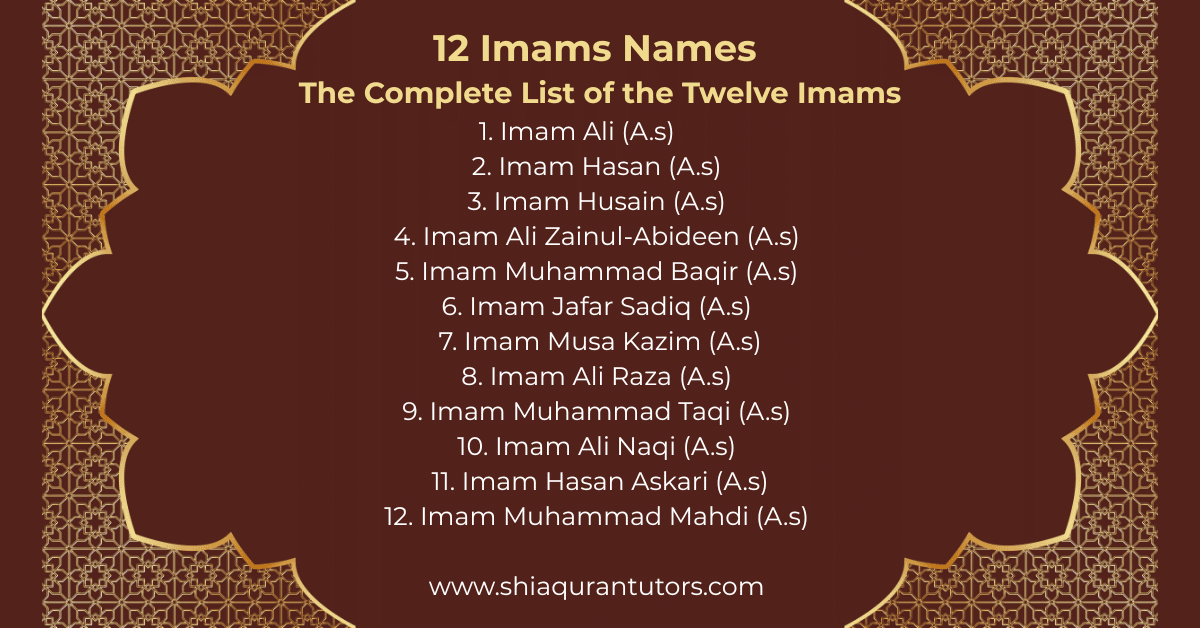
12 Imams Names – The Complete List of the Twelve 12 Imams
Who are the 12 Imams in Shia Islam?
The Twelve Imams are divinely appointed leaders who took over from the Prophet ﷺ in leading mankind. Every Imam is a descendant of Imam Ali (A.S) and Lady Fatima Zahra (S.A) — the Prophet’s dearly loved daughter.
They are considered to be infallible (Ma’soom), sinless, and having profound divine knowledge. The Imams went on disseminating the pure teachings of Islam, sometimes in adverse political conditions, so that the religion was kept pure and authentic.
Full List of 12 Imams Names (With Brief Information)
Following is the list of the 12 Imams Names in sequence along with their titles and a brief introduction to each:
- Imam Ali ibn Abi Talib (A.S.)
Title: Amir al-Mu’minin (Leader of the Faithful)
Born: 13 Rajab, 600 CE in the Holy Kaaba, Makkah
Martyrdom: 21 Ramadan, 661 CE in Kufa
Imam Ali (A.S.) was the first Imam, Prophet Muhammad ﷺ’s cousin and son-in-law.
Renowned for his unparalleled courage, justice, and eloquence, he authored the Nahjul Balagha, a series of sermons and letters replete with divine wisdom.
His life is an epitome of courage, truth, and justice.
- Imam Hasan ibn Ali (A.S.)
Title: Al-Mujtaba
Born: 15 Ramadan, 625 CE in Madinah
Martyrdom: 28 Safar, 670 CE
Imam Hasan (A.S.) was famous for being patient, generous, and peaceful.
He signed a peace agreement with Muawiya to safeguard Islam from internal strife, demonstrating that victory comes only by maintaining faith, not through power.
- Imam Husain ibn Ali (A.S.)
Title: Sayyid al-Shuhada (Leader of Martyrs)
Born: 3 Sha’ban, 626 CE in Madinah
Martyrdom: 10 Muharram, 680 CE in Karbala
Imam Husain (A.S.) offered his life at Karbala to save Islam from oppression. His courageous stand for truth and justice is an everlasting sign of faith and resistance against tyranny.
- Imam Ali ibn al-Husain (A.S.)
Title: Zainul Abidin / As-Sajjad
Born: 5 Sha’ban, 659 CE in Kufa
Martyrdom: 25 Muharram, 713 CE in Madinah
Imam Zainul Abidin (A.S.) is also called The Ornament of the Worshippers. He remained alive after Karbala and left behind the spiritual gem Sahifa Sajjadiyya, a compilation of sincere supplications.
- Imam Muhammad ibn Ali (A.S.)
Title: Al-Baqir al-Uloom (The Splitter of Knowledge)
Born: 1 Rajab, 677 CE in Madinah
Martyrdom: 7 Dhu al-Hijjah, 732 CE
Imam Baqir (A.S.) opened the doors of Islamic knowledge, teaching scholars and preserving the true interpretation of the Qur’an.
- Imam Jafar ibn Muhammad (A.S.)
Title: As-Sadiq (The Truthful)
Born: 17 Rabi’ al-Awwal, 702 CE in Madinah
Martyrdom: 25 Shawwal, 765 CE
Founder of the Ja’fari school of thought, Imam Jafar as-Sadiq (A.S.) educated thousands, including prominent scholars. His teachings form the intellectual backbone of Shia jurisprudence and theology.
- Imam Musa ibn Jafar (A.S.)
Title: Al-Kazim (The One Who Controls Anger)
Born: 7 Safar, 745 CE in Al-Abwa
Martyrdom: 25 Rajab, 799 CE in Baghdad
Imam Musa al-Kazim (A.S.) spent years in captivity under Abbasid rulers, and demonstrated perfect patience, worship, and forgiveness.
- Imam Ali ibn Musa (A.S.)
Title: Ar-Ridha (The Contented)
Born: 11 Dhu al-Qa’dah, 766 CE in Madinah
Martyrdom: 17 Safar, 818 CE in Toos (Mashhad)
Imam Ridha (A.S.) was renowned for his wisdom and conversations with scholars of all religions. His shrine in Mashhad, Iran is a prime spiritual destination for millions of people.
- Imam Muhammad ibn Ali (A.S.)
Title: Al-Jawad / At-Taqi (The Generous / The Pious)
Born: 10 Rajab, 811 CE in Madinah
Martyrdom: 29 Dhu al-Qa’dah, 835 CE in Baghdad
In spite of his tender age, Imam Muhammad al-Jawad (A.S.) surprised scholars with his divine wisdom and spiritual maturity.
- Imam Ali ibn Muhammad (A.S.)
Title: Al-Hadi / An-Naqi (The Guide / The Pure)
Born: 2 Rajab, 827 CE near Madinah
Martyrdom: 3 Rajab, 868 CE in Samarra
Imam Hadi (A.S.) led his people by wisdom and letters and reinforced their faith in an age of extreme oppression.
- Imam Hasan ibn Ali (A.S.)
Title: Al-Askari
Born: 8 Rabi’ al-Thani, 846 CE in Madinah
Martyrdom: 8 Rabi’ al-Awwal, 874 CE in Samarra
Imam Hasan al-Askari (A.S.) lived under strict surveillance but continued to guide his followers through his writings and trusted representatives.
- Imam Muhammad ibn Hasan (A.S.)
Title: Al-Mahdi (The Awaited One) / Sahib uz-Zaman (Master of the Age)
Born: 15 Sha’ban, 868 CE in Samarra
Status: In Occultation — will reappear by Allah’s command
Imam Mahdi (A.S.) is the last Imam who will return to bring world peace and justice. Shia Muslims believe in his return with hope and faith.
The Role and Significance of the 12 Imams
The 12 Imams serve as the spiritual successors of the Prophet ﷺ, protecting Islam from distortion and guiding believers toward truth. Their lives reflect knowledge, sacrifice, patience, and devotion. Each Imam played a vital role in preserving the Qur’an’s true meaning and embodying its teachings. Their example remains a living roadmap for those who seek closeness to Allah.Following the 12 Imams in Modern Life
In today’s world, following the path of the Imams means embodying their values — justice like Imam Ali (A.S), sacrifice like Imam Husain (A.S), knowledge like Imam Sadiq (A.S.), and patience like Imam Kazim (A.S.). True followers strive to be kind, honest, prayerful, and just, while spreading peace and knowledge.To deepen your Islamic understanding, explore our specialized online courses at Shia Quran Tutors such as:Conclusion – The Path of Ahlulbayt and True Guidance
The 12 Imams (A.S) represent the eternal chain of divine light. They are not just historical figures but living sources of guidance whose teachings continue to inspire hearts across generations. By remembering their names, following their path, and teaching others about them, we connect ourselves to the pure message of Islam — the message of love, justice, and truth.Conclusion – The Path of Ahlulbayt and True GuidanceThe 12 Imams (A.S) are the unbroken chain of divine light. They are not only figures from history but a source of guidance who live on and whose teachings touch hearts across generations.By recalling their names, tracing their steps, and imparting others with their knowledge, we tie ourselves to the untainted message of Islam — the message of justice, love, and truth.May Allah dignify us to tread in the footsteps of the 12 Imams (A.S) and be part of the allies of Imam Mahdi (A.J), the savior promised to humanity. For a broader historical context, you can visit Al-Islam.orgFAQs About the 12 Imams:
- Who are the 12 Imams in Shia Islam?
They are the twelve divinely appointed leaders from the progeny of Imam Ali (A.S.) and Lady Fatima Zahra (S.A.), starting with Imam Ali (A.S.) and concluding with Imam Mahdi (A.S.).
- Why are the 12 Imams significant?
They maintain Islam’s authentic teachings, spiritually guide believers, and are role models for humanity.
- Who is the last Imam?
The last Imam is Imam Muhammad al-Mahdi (A.S.), who is in occultation and will reappear to enforce justice and peace.
Start Your Free Quran Class Trial Today!
The Power of 4 Quls in Quran: Definitive Protection Guide

When is Ramadan 2026? Expected Dates & Global Guide

Shab-e-Barat 2026: Date, Night of Forgiveness, Amaal & Shia Beliefs

Learn Quran Online | Classes, Tajweed, Tafseer Guide

Top Islamic Studies Courses Online: Shia Quran Tutors

3 Responses