
Najaf to Karbala Arbaeen Walk: Complete Guide for First-Time Pilgrims
The Najaf to Karbala walk is one of the world’s largest annual pilgrimages and an important spiritual journey for followers of the Ahlul Bayt (AS). Every year, millions of pilgrims walk toward the shrine of Imam Hussain (AS) in Karbala during the days leading to Arbaeen.
The journey is approximately 80 kilometres and is commonly completed over two to four days. Although food, water and resting facilities are widely available through volunteer-run mawakeb, the walk remains physically demanding. First-time pilgrims should prepare for long walking hours, extreme heat, heavy crowds and changing travel conditions.
This guide explains the Najaf to Karbala distance, route poles, packing essentials, footwear, hydration, accommodation, medical preparation and practical guidance for women, children and elderly pilgrims.
Quick Answer
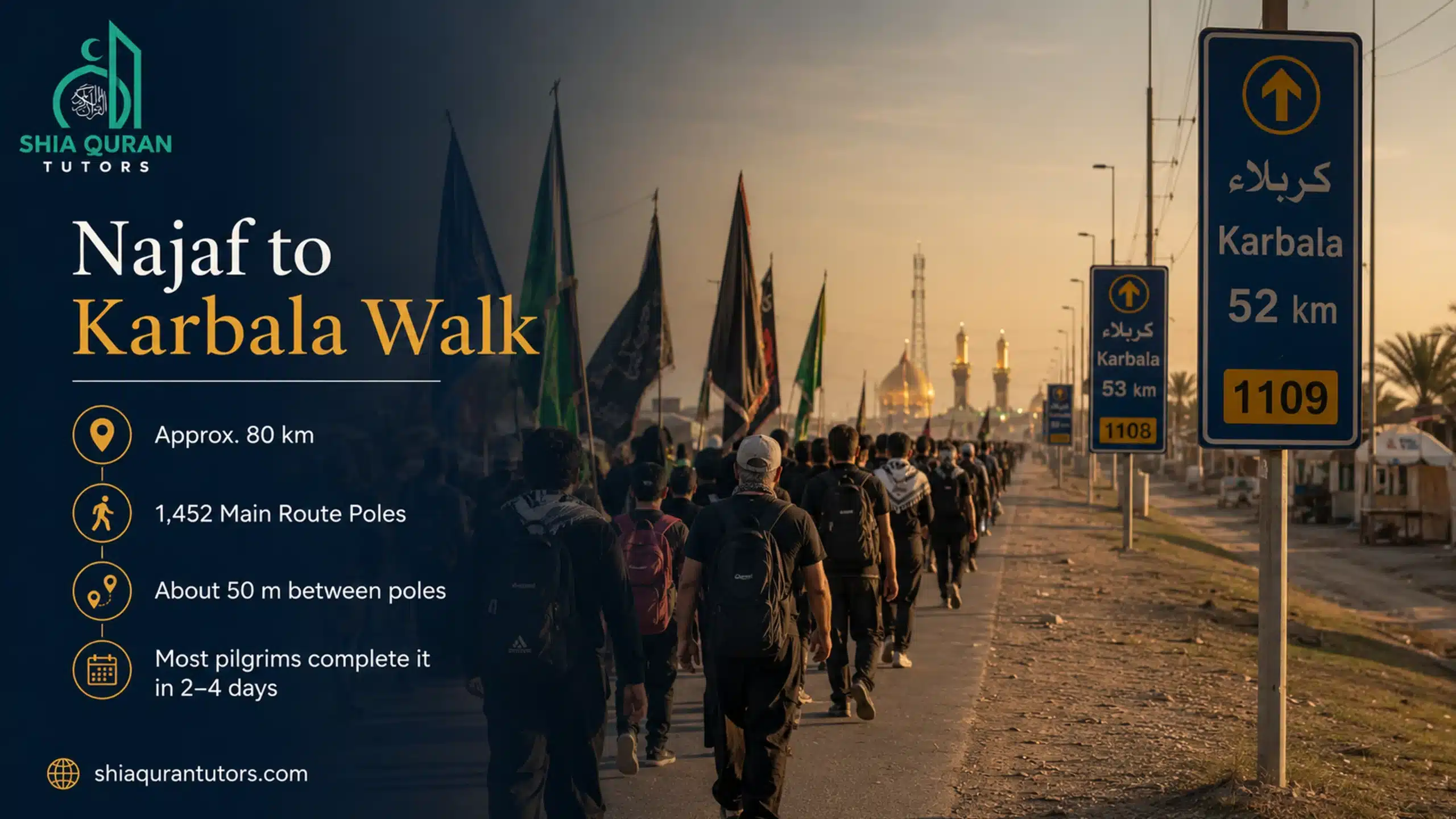
The Najaf to Karbala walk is approximately 80 kilometres or 50 miles. The main route contains 1,452 numbered poles, generally placed about 50 metres apart. Most pilgrims complete the journey in two to four days, depending on their health, walking speed, weather and crowd conditions. Pilgrims should pack lightly, wear broken-in walking shoes, protect themselves from heat and verify current visa, border, flight and security requirements before travelling.
Table of Contents
Najaf to Karbala Walk Distance and Route
The commonly stated Najaf to Karbala distance is approximately 80 kilometres or 50 miles.
Many pilgrims begin near the shrine of Imam Ali (AS) in Najaf. They then move toward the main Najaf–Karbala highway, where the numbered pole system begins. The journey ends in Karbala near the shrines of Imam Hussain (AS) and Hazrat Abbas (AS).
The exact distance may vary slightly depending on:
- The pilgrim’s starting location in Najaf
- The route used to reach the main highway
- Detours caused by crowds or security arrangements
- The final route taken inside Karbala
- The pilgrim’s accommodation or meeting point
For planning purposes, pilgrims should prepare for an approximately 80-kilometre journey rather than treating the figure as an exact door-to-door measurement.
| Planning Detail | Practical Estimate |
|---|---|
| Approximate distance | 80 km or 50 miles |
| Main route poles | 1,452 numbered poles |
| Approximate pole spacing | 50 metres |
| Actual walking time | Approximately 20–27 hours |
| Common completion time | Two to four days |
Pilgrims can also review Al-Islam.org’s detailed guide to the Najaf–Karbala walking route before travelling.
Understanding the Arbaeen Walk Poles
One of the most useful features of the Najaf to Karbala walk is the numbered pole system.
The main highway route is commonly described as having 1,452 numbered poles. These poles are generally placed approximately 50 metres apart and help pilgrims measure progress, arrange meeting points and estimate the remaining distance.
Multiplying 1,452 poles by approximately 50 metres gives around 72.6 kilometres. The full journey is still commonly described as approximately 80 kilometres because the pole calculation may not include:
- Walking inside Najaf before reaching the first main pole
- The final approach inside Karbala
- Temporary route diversions
- Walking between accommodation, shrines and meeting points
Some guides also mention a separate set of poles inside Najaf. Pilgrims should not add every pole count found online and assume that it represents one continuous highway measurement.
How to Use the Pole System
Before starting the walk, agree with your family or group on specific pole numbers as meeting points.
For example, your group may decide to regroup every 100 or 150 poles. This can be more practical than depending entirely on mobile phones because mobile signals may become weak or overloaded during large crowds.
Write important pole numbers on paper and save them in more than one phone.
Do not rely on outdated online meeting-point instructions without confirming the location physically. Barriers, tents, security zones and crowd routes may change.
How Many Days Does the Najaf to Karbala Walk Take?
Most pilgrims complete the Najaf to Karbala walk in two to four days.
The total actual walking time is often estimated at approximately 20 to 27 hours. However, the real duration depends on:
- Physical fitness
- Age and medical condition
- Weather and temperature
- Crowd density
- Number of rest stops
- Time spent at mawakeb
- Whether the pilgrim walks during the day or night
- Travelling with children or elderly family members
A strong and experienced walker may complete the route faster, but first-time pilgrims should not make speed their main objective.
A slower journey with proper rest, hydration and spiritual focus is safer and more meaningful than rushing to complete the route.
Date Accuracy and Moon-Sighting Note
Arbaeen is observed on 20 Safar, forty days after Ashura.
For 1448 AH, IMAM-US confirmed Tuesday, 4 August 2026, as 20 Safar for North America. Some calculated Islamic calendars place 20 Safar on Monday, 3 August 2026.
The final date in Iraq should be followed according to the announcement recognised by the relevant religious authorities and shrine administrations.
Islamic dates may vary by one day between countries and regions because of differences in crescent visibility and moon-sighting methods.
Pilgrims should therefore avoid booking critical travel arrangements based only on an unverified online calendar.
Visa, Security and Travel Documents
Travel rules for Iraq can change quickly, especially during periods of regional tension, airspace disruption or large religious gatherings.
Important Warning
Current visa, security, airline, airspace and land-border requirements must be rechecked before travel. No website, travel agent or pilgrimage guide can guarantee entry into Iraq, uninterrupted flights, open borders or personal safety.
Pilgrims should check:
- The official Iraqi eVisa portal
- The nearest Iraqi embassy or consulate
- Their airline
- Their national foreign affairs or travel advisory website
- Their registered pilgrimage group
- Official Iraqi announcements
- Relevant Ministry of Religious Affairs instructions
Most international pilgrims will require a visa or prior travel authorisation. Requirements vary according to nationality.
Visa eligibility, required documents and application instructions should be checked directly through the official Iraqi eVisa portal.
Essential Documents to Carry
Pilgrims should carry:
- A passport with sufficient remaining validity
- A printed copy of the Iraqi visa or eVisa approval
- Flight and onward-travel details
- Hotel, group or accommodation information
- Travel insurance documents
- Emergency contact information
- A list of allergies and medical conditions
- A list of medicines and their generic names
- Printed and digital copies of all important documents
- Passport-sized photographs
Keep the original passport in a secure document pouch. Store copies separately and save encrypted copies online where possible.
Pakistani pilgrims should also check the latest Ministry of Religious Affairs instructions and any requirements related to approved Zaireen Group Organizers.
Physical Preparation Before the Arbaeen Walk
Pilgrims should begin physical preparation several weeks before travelling.
Start with short daily walks and gradually increase the distance. At least once or twice before travelling, walk while wearing the same shoes, socks and backpack that you intend to use in Iraq.
Training may include:
- Regular walking
- Gradually increasing distance
- Walking on different surfaces
- Practising with a light backpack
- Stretching the calves and legs
- Building basic lower-body strength
- Learning how your body responds to heat
People with heart disease, diabetes, respiratory illness, arthritis, mobility difficulties or other chronic conditions should consult their doctor before undertaking the walk.
Best Footwear for the Arbaeen Walk
Footwear is one of the most important parts of Arbaeen preparation.
Wear supportive, breathable and well-fitted walking shoes. Never start the pilgrimage in completely new shoes.
New footwear may cause:
- Blisters
- Heel pain
- Toe injuries
- Skin irritation
- Ankle discomfort
Use moisture-managing socks and carry at least one spare pair in an easily accessible part of your bag.
Pilgrims who prefer sandals should test them carefully before travel. Open footwear may expose the feet to dust, heat, stones and accidental contact in crowded areas.
Carry blister dressings, medical tape and basic foot-care supplies.
What to Pack for the Arbaeen Walk
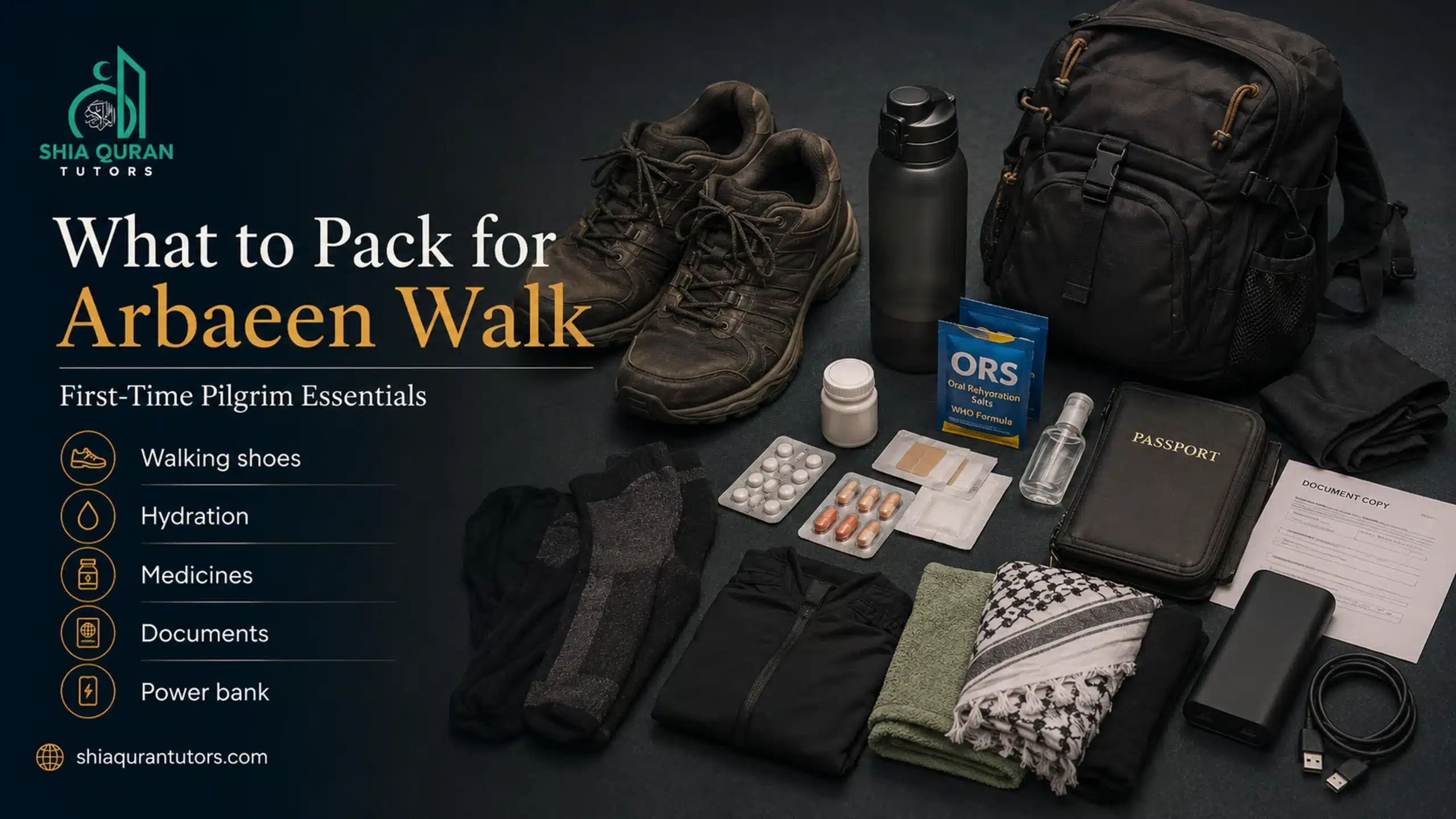
The best Arbaeen packing list is light, practical and focused on essential needs.
Avoid carrying a heavy suitcase or oversized backpack during the walk. Every unnecessary item increases pressure on the feet, shoulders and lower back.
| Item | Purpose |
|---|---|
| Small lightweight backpack | Carries daily essentials without excessive weight |
| Secure document pouch | Protects passport, visa and money |
| Refillable water bottle | Supports regular hydration |
| Oral rehydration sachets | Helps replace fluids and salts when used correctly |
| Personal medicines | Prevents missed doses during the journey |
| Power bank and charging cable | Keeps phones available for communication |
| Spare socks | Reduces moisture and friction |
| Blister dressings | Provides early foot protection |
| Hand sanitiser and tissues | Supports hygiene in crowded facilities |
| Light sheet or sleeping liner | Useful at mawakeb and shared resting areas |
| Breathable modest clothing | Supports comfort, respect and heat management |
| Small towel | Useful for washing and cooling |
Medicines and Medical Supplies
Carry enough prescribed medication for the full journey, with additional doses in case of delays.
Keep medicines:
- In their original packaging
- Inside hand luggage
- Away from direct sunlight where required
- With a written prescription or medical letter when appropriate
Do not depend on finding the same medicine or brand in Iraq.
Pilgrims with serious allergies should carry their emergency medication and ensure that companions know how to use it.
Prepare spiritually as well as physically. Pilgrims can study the pronunciation and meaning of Ziyarat Arbaeen through the Shia Quran Tutors Ziyarat and Duas course and request a one-to-one free trial class.
For related reading, visit:
Ziyarat e Ashura
Ashura 2026: Complete Date, Aamal and Ziyarat Guide
Heat, Hydration and Medical Safety
Arbaeen may occur during extremely hot weather.
Late-July and early-August temperatures in Najaf and Karbala can exceed 40°C and may approach or exceed the upper 40s during severe heat.
Weather forecasts change, so pilgrims should check a reliable forecast shortly before travel
How to Reduce Heat Risk
Pilgrims should:
- Avoid the hottest part of the day where possible
- Walk during cooler evening, night or early-morning hours
- Rest regularly in shaded areas
- Drink water throughout the journey
- Use oral rehydration products according to package instructions
- Wear breathable, loose and modest clothing
- Cover the head from direct sunlight
- Reduce walking distance when feeling unwell
- Never ignore symptoms to keep up with a group
Warning Signs of Heat Illness
Possible signs of heat exhaustion include:
- Dizziness
- Headache
- Nausea
- Muscle cramps
- Unusual weakness
- Heavy sweating
- Intense thirst
- Rapid heartbeat
Move the person into shade, loosen unnecessary clothing, cool the body and seek medical help.
Confusion, collapse, seizure, unconsciousness or very hot skin may indicate heatstroke. Heatstroke is a medical emergency and requires immediate professional treatment.
Food and Water Safety During Arbaeen
Mawakeb provide enormous amounts of food and water as an act of service to the pilgrims of Imam Hussain (AS).
However, pilgrims should still use basic food-safety precautions.
Choose:
- Freshly cooked food
- Food that is served hot
- Sealed or trusted drinking water
- Clean utensils
- Mawakeb with organised food handling
Avoid food that appears undercooked, has been left uncovered for a long time or smells unusual.
Wash or sanitise your hands before eating, especially after using shared facilities.
Pilgrims with allergies, diabetes, digestive conditions or special dietary needs should carry suitable backup food.
Mawakeb, Accommodation and Etiquette
Mawakeb are volunteer-run service stations established along the pilgrimage route.
Many provide:
- Food
- Drinking water
- Tea and other beverages
- Sleeping space
- Toilets and washing facilities
- Basic medical assistance
- Phone charging
- Foot massage or simple foot care
These services are offered voluntarily in honour of Imam Hussain (AS). Pilgrims should receive them with gratitude and respect.
Mawakeb Etiquette
Pilgrims should:
- Take only what they need
- Avoid wasting food and water
- Queue patiently
- Keep shared areas clean
- Respect sleeping arrangements
- Avoid occupying excessive space
- Ask permission before photographing people
- Respect volunteers and local customs
- Give priority to elderly people, children and those with disabilities
- Avoid arguments over food, space or service
Free food and accommodation are common, but they are not guaranteed. Mawakeb may become full or may not meet every dietary, privacy or medical need.
Keep emergency money and an alternative transport or accommodation plan.
Women’s Arbaeen Walk Guide
Women participate in the Arbaeen walk in large numbers, but careful preparation remains important.
Women should travel with a trusted group, especially when unfamiliar with the route or local arrangements.
Recommended preparations include:
- Loose, breathable and modest clothing
- Comfortable abaya or chador
- Spare hijab and underlayers
- Hijab pins
- Personal hygiene supplies
- Menstrual products
- Secure document pouch
- Essential medication
- Power bank
- Agreed meeting points
- Emergency telephone numbers
Sleeping and washing privacy may vary between mawakeb. Women should confirm arrangements with their group when possible.
Personal fiqh questions related to prayer, purity, menstruation or other religious matters should be checked according to the rulings of the pilgrim’s own marja.
No guide should present the route as completely risk-free for women or any other pilgrim.
Frequently Asked Questions
How long is the Najaf to Karbala walk?
How many poles are on the Arbaeen walk?
How many days does the Najaf to Karbala walk take?
What are the best shoes for the Arbaeen walk?
Is the Arbaeen walk suitable for women?
Learn Ziyarat Arbaeen with Meaning and Correct Pronunciation
Reading the words is an important beginning. With personal guidance, students can also improve their Arabic pronunciation, understand each passage and study the message of Imam Hussain (A.S.) in greater depth. Shia Quran Tutors provides individual online lessons for children and adults through its Ziyarat & Duas course.
- ✓ Personal one-to-one lessons
- ✓ Arabic pronunciation and recitation support
- ✓ English or Urdu explanation of meaning
Flexible online learning for international students in the USA, UK, Canada, Europe, Australia, Pakistan and other regions.
Conclusion
The Najaf to Karbala walk requires more than physical strength. First-time pilgrims should prepare their bodies, organise essential documents, wear tested footwear, manage heat carefully and maintain a reliable communication and transport plan.
The route is supported by extraordinary hospitality, but pilgrims should not assume that food, accommodation, internet access, medical care or border entry will always be available.
Current visa, security, airspace, airline and border requirements must be rechecked immediately before travelling.
With realistic planning, patience, humility and spiritual preparation, the Najaf to Karbala walk can become a deeply meaningful journey of remembrance and loyalty to Imam Hussain (AS).
Pilgrims who wish to prepare spiritually can study Ziyarat Arbaeen, the Fiqh of Ahlul Bayt and Shia Islamic beliefs through one-to-one online classes with Shia Quran Tutors. A free trial class is available for adults, parents and children in the USA, UK, Canada, Australia, Europe, Pakistan and the Gulf.
Students seeking one-to-one help with pronunciation, meaning, Aqaid, Fiqh and Shia Islamic Studies may explore the Ziyarat & Duas course and request a free trial class.

Arrange your trial step by step, confirm your local time and lesson link, and keep a clear record of regular tuition.

Evaluate an Islamic studies teacher through relevant qualifications, source handling and a short teaching demonstration.

Home Shia Quran Teacher for Shia Muslims and a Family Learning Plan Plan Quran learning around your family. A Shia Quran teacher for Shia Muslims should help a learner read carefully while making space for the religious questions their family actually asks. Parents may want lessons connected to the Ahlul Bayt (AS), while an adult […]
2 Responses