Furoo e Deen: The Branches of Islam.
Islam is not merely a set of beliefs — it is a complete code of life. It offers guidance for every aspect of human existence: spiritual, moral, social, and economic. The framework of the religion is exquisitely balanced between beliefs and deeds, embodied in two core categories — Usool-e-Deen (Roots of Religion) and Furoo-e-Deen (Branches of Religion).
- Usool-e-Deen speaks of what a Muslim believes — like believing in Tawheed (Oneness of Allah), Adl (Justice), Nubuwwah (Prophethood), Imamat, and Qiyamat (Day of Judgment).
- Furoo-e-Deen, by contrast, details what a Muslim does — the practical and moral obligations that follow from those beliefs.
The term “Furoo” refers to branches, illustrating how these acts branch out from the deep roots of faith. If Usool-e-Deen is the root system of a tree, Furoo-e-Deen is the outward structure providing fruit, shade, and beauty — the expression of a living, practicing Islam.
Understanding Furoo-e-Deen
Furoo-e-Deen represents the practical side of Islam — the duties that express a Muslim’s devotion to Allah and responsibility toward others. These acts strengthen a believer’s relationship with the Creator while nurturing social justice, discipline, and compassion.
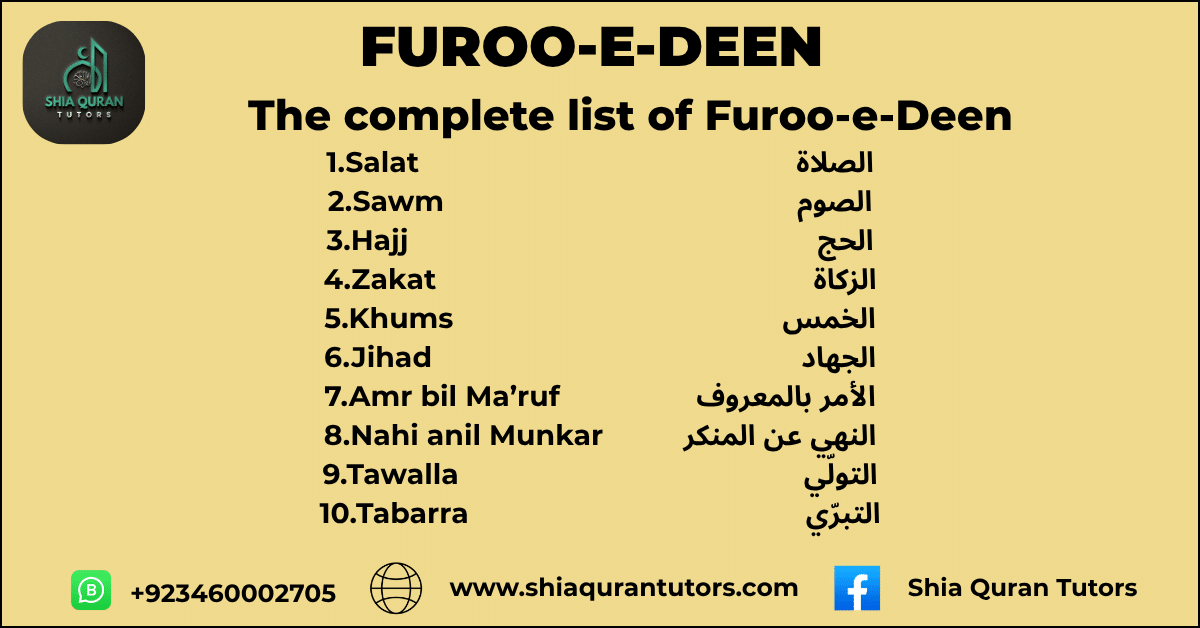
There are ten principal branches (Furoo) of Shia Islam, and each one is an essential part of a Muslim’s moral and spiritual life. They all contribute to a proper and righteous path of living.
Ten Branches of Islam (Furoo-e-Deen)
- Salat (Prayer).
Salat is the foundation of Islamic practice — recited five times a day. It is a direct link between the believer and Allah, promoting spiritual self-discipline and awareness.
“Indeed, prayer prohibits immorality and wrongdoing.”
(Qur’an 29:45)
Through Salat, a Muslim cleanses the heart, builds self-control, and continually renews consciousness of Allah’s presence.
- Sawm (Fasting).
Sawm or fasting is practiced in the sacred month of Ramadan. Muslims fast from dawn to sunset and refrain from food, drink, and worldly desires, learning self-discipline, compassion, and righteousness.
Fasting cleanses both body and soul, instilling patience and sympathy for the poor. It is not abstinence of the body, but a spiritual withdrawal from sin and excess.
- Hajj (Pilgrimage).
Hajj is a journey to Mecca — a duty for all Muslims who can afford it and are physically fit, at least once in a lifetime. It is a reflection of unity, humility, and submission to Allah.
During Hajj, millions wear plain white clothing, equal in the eyes of their Creator. The rites re-create the tradition of Prophet Ibrahim (a.s.) and reinforce the idea of universal brotherhood of Islam.
- Zakat (Charity).
Zakat is a mandatory charity, intended to purify wealth and reduce social inequality. It ensures that the wealth of society circulates among all classes, creating balance and compassion.
Zakat nurtures generosity and social responsibility. It is often used to assist the poor, orphans, and those in need, thereby maintaining the moral and economic health of the community.
- Khums (One-Fifth Tax).
Khums is literally “one-fifth.” It is the duty to give 20% of some types of savings and earnings for the good of society. Khums cares for the poor, keeps the mosques, and finances religious studies.
In Shia Islam, Khums is specifically highlighted as a tool of economic justice and religious viability. It makes sure that wealth supports the benefit of both faith and society.
- Jihad (Striving in the Way of Allah).
Jihad means to exert effort or to struggle in the path of Allah. It is not war; in fact, it implies all efforts to maintain truth, justice, and righteousness.
There are two types of Jihad:
- Greater Jihad: Inner struggle against one’s ego, desires, and sins.
- Lesser Jihad: Physical protection from oppression or injustice when needed.
Therefore, Jihad represents self-reform, fortitude, and devotion to uprightness.
- Amr bil Ma’ruf (Enjoining Good).
Amr bil Ma’ruf is the responsibility of exhorting good action and virtue. It implies encouraging righteousness
— assisting others to do what is right in individual, social, and spiritual life.
A Muslim is to encourage goodness through good advice, example, and enticement so that virtue can flourish in society.
- Nahi anil Munkar (Forbidding Evil).
This is a corollary to the former. Nahi anil Munkar imposes upon Muslims the duty to deter evil deeds and shield society from injustice, corruption, and immorality.
By performing this duty, a believer assists in upholding moral order and justice, preventing evil from dominating.
This principle shows Islam’s serious concern for humanity’s moral well-being.
- Tawalla (Love for the Family of the Prophet).
Tawalla is loving, respecting, and obeying the Prophet Muhammad (S.a.w) and his Ahlul Bayt (A.s) — the immaculate family who are the personifications of purity and righteousness.
This affection isn’t merely emotional but also practical — by emulating their teachings and lifestyle, a Muslim remains in touch with divine guidance and ethical righteousness.
- Tabarra (Disassociation from the Enemies of the Prophet’s Family).
Tabarra is about dissociating from oppression and falsehood — keeping away from those who are against truth, morality, or the Prophet’s family. It maintains a believer’s allegiance to righteousness and justice.
Tabarra strengthens one’s moral foundation against oppression and corruption, instructing Muslims to side with truth even when it is challenging.
The Wisdom Behind furoo-e-Deen
The branches of Islam are not separate rituals — they comprise a balanced structure that enhances the believer’s relationship with Allah and society.
Salat cleanses the heart.
Zakat and Khums enhance social justice.
Jihad, Amr bil Ma’ruf, and Nahi anil Munkar maintain morality and truth.
Tawalla and Tabarra maintain spiritual loyalty and justice.
All of them together establish balance between faith, action, and social responsibility.
Learn More About Furoo e Deen
In order to thoroughly learn Islamic beliefs and responsibilities, enroll in our expert online Islamic study courses at ShiaQuranTutors.com
Suggested Courses:
Conclusion
Furoo-e-Deen is the pragmatic form of faith. Just like the power of a tree also lies in its roots and branches, the belief (Usool) of a Muslim becomes complete only if it is coupled with action (furoo).
By abiding by these ten principles in all earnest, Muslims not only make themselves accountable to Allah but also contribute to the formation of a just, caring, and peaceful society.
“Faith without action is like a tree without fruit.”
May Allah give us the strength to adhere to both the roots and branches of our faith and live as per His goodwill.
Ameen.
Key Theme: Understanding Furoo-e-Deen (The Branches of Faith)
Furoo-e-Deen, meaning “Branches of Religion,” represents the practical pillars of Islam that guide how a believer lives their daily life with justice, discipline, and compassion. These ten fundamental principles—such as Salat (Prayer), Sawm (Fasting), Hajj (Pilgrimage), Zakat (Charity), and Jihad (Striving for good)—are essential for building a balanced and righteous Muslim character.
Unlike Usul-e-Deen (Roots of Religion), which deal with faith and belief, Furoo-e-Deen focuses on actions that reflect true submission to Allah’s will. Each branch teaches an important moral lesson: from personal worship to community service, from honesty to patience, from respect to social justice.
To help students and readers deepen their understanding, we’ve also shared a Downloadable PDF of Furoo-e-Deen that lists all the branches with brief explanations and Quranic references.
For more Quranic learning and moral development courses, visit our Basic Qaida Course or Quran with Tajweed Course — both designed to strengthen your connection with Allah through correct recitation and understanding.
You may also explore authentic Islamic teachings and references from Al-Islam.org, a trusted educational resource for further reading and study.
FAQs About Furoo e Deen:
- What does Furoo e Deen mean?
It means “branches of religion” — the practical aspects of Islam that guide a Muslim’s daily actions. - How many Furoo e Deen are there in Shia Islam?
There are ten branches of religion, which include prayer, fasting, charity, pilgrimage, and more.
- What is the difference between Usul e Deen and Furoo e Deen?
Usul e Deen are the beliefs of Islam, while Furoo e Deen are the actions based on those beliefs. - Why is Furoo e Deen important?
Because it transforms faith into practice, ensuring Muslims live by the teachings of Islam.
Start Your Free Quran Class Trial Today!
The Power of 4 Quls in Quran: Definitive Protection Guide
When is Ramadan 2026? Expected Dates & Global Guide
Top Islamic Studies Courses Online: Shia Quran Tutors
Learn Quran Online | Classes, Tajweed, Tafseer Guide
Vital Secrets of Surah Waqiah for Daily Abundance