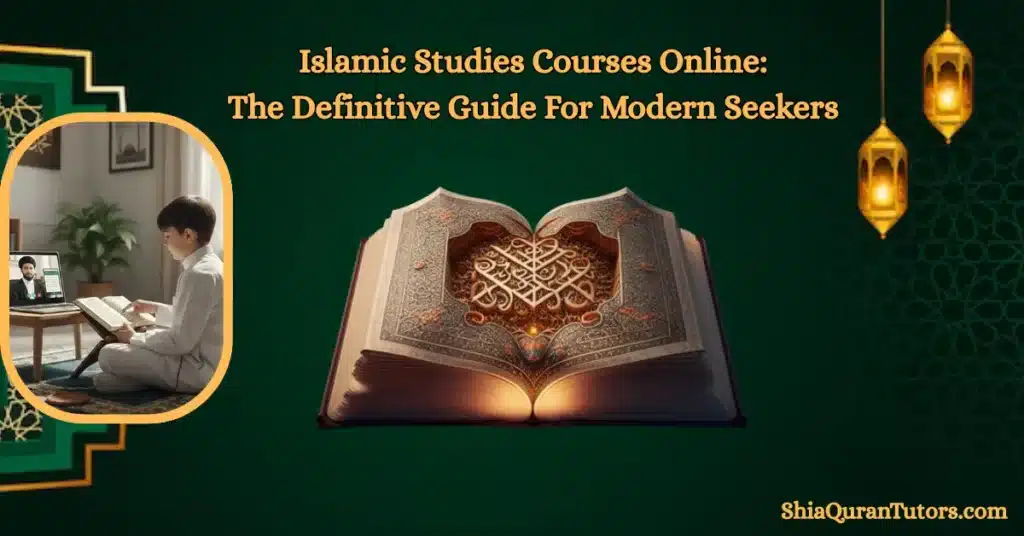
Islamic Studies Courses Online: The Definitive Guide for Modern Seekers
I remember sitting in a small, crowded library in London a decade ago, surrounded by dusty volumes of Hadith and Fiqh. Back then, if you wanted to deepen your understanding of the Ahlulbayt’s teachings, you had to physically travel, often through rain or heavy traffic, to find a qualified scholar. Today, the landscape has changed entirely. As a content strategist and educator who has spent years transitioning traditional curricula into digital spaces, I have seen how Islamic Studies Courses Online have revolutionized religious literacy for the global diaspora.
At Shia Quran Tutors, we believe that geographic boundaries should never be a barrier to spiritual growth. Whether you are looking for an Islamic course online in USA or seeking structured Online classes in the UK, the digital world offers an unprecedented opportunity to engage with your faith.
The Digital Renaissance of Faith-Based Learning
The shift toward virtual education isn’t just about convenience; it is about necessity. Recent data from 2024 and 2025 suggests that the Muslim population in the West is not only growing but is significantly more engaged in formal education than previous generations. According to Pew Research, nearly 30% of Muslim adults in the USA are current students, a rate much higher than the national average.
When I first started designing online programs, I was skeptical. Could a screen replace the Barakah (blessing) of a physical classroom? What I found was surprising: for many, especially those Learning Islam for beginners, the privacy and pace of an Online Islamic Course actually reduced the anxiety of asking “simple” questions. It created a safe space for genuine inquiry.
Why Online Learning is Thriving
Accessibility: No matter how remote your location, you can connect with specialized Shia Quran Tutors.
Personalization: One-on-one sessions allow for a curriculum tailored to your specific level of knowledge.
Consistency: Busy professionals and students can fit Quran study into schedules that would make attending a physical madrasa impossible.
What Defines a High-Quality Online Islamic Course?
Expertise in this field requires more than just a Zoom link. To truly benefit from Islamic Studies Courses Online, you need a curriculum that balances the “How” with the “Why.”
For example, when we teach Salah (prayer), a beginner-level course shouldn’t just show you where to place your hands. It should explain the philosophical depth of Sajdah (prostration) and how it connects to our innate human need for humility. This is the difference between rote memorization and true Learning Islam for beginners.
Core Pillars of a Comprehensive Curriculum
A well-rounded Online Islamic Course usually focuses on four essential areas:
Aqaid (Beliefs)
Exploring the roots of religion (Usul ad-Din)—Tawhid, Adalah, Nubuwwah, Imamah, and Ma’ad.
Fiqh (Jurisprudence)
Practical rules for daily life, from Taharah (purity) to modern ethical dilemmas in finance.
Akhlaq (Ethics)
The refinement of the soul and the development of a character that reflects the teachings of the Prophet (s) and his family.
Tarikh (History)
A critical look at the lives of the Ma’sumeen (as) and the evolution of the Muslim Ummah.
Regional Spotlight: Islamic Course Online in USA and UK
The needs of a student in New York often differ from those in London. Through my work with students across these regions, I’ve noticed distinct cultural contexts that influence how we deliver Islamic Studies Courses Online.
Islamic Course Online in USA
In the United States, there is a strong emphasis on identity and social justice. Students often seek an Islamic course online in USA that helps them navigate being a minority in a secular, fast-paced society. Our sessions for US students frequently delve into how Islamic ethics can be applied to corporate environments and community activism.
Islamic Course Online in UK
In the UK, the community is often more established, with a deep history. Students seeking an Islamic course online in UK often look for academic rigor and a connection to the traditional scholarly methods of Najaf and Qom. They value a structured approach that mirrors the formal education they receive in British universities.
The Practicalities of Online Classes
If you are new to the idea of Online classes, you might wonder about the technical requirements. You don’t need a high-end studio. Most of our students at Shia Quran Tutors succeed with just a stable internet connection, a quiet corner, and a dedicated notebook.
Selecting the Right Platform
One-on-One vs. Group: Beginners usually benefit more from private sessions where the tutor can focus on their specific pronunciation during Quran study.
Vetted Tutors: Ensure the academy performs background checks and has a transparent vetting process for their scholars.
Interactive Tools: Look for courses that use digital whiteboards or screen-sharing to make the learning process visual.
Deep Dive: Quran Study and the Science of Tajweed
You cannot separate Islamic Studies Courses Online from the study of the Quran itself. However, many beginners make the mistake of rushing into translation before they have mastered the phonetics.
In my experience, the beauty of the Quran is often lost if we ignore Tajweed. Proper recitation is not just about “sounding religious”; it is about preserving the linguistic integrity of the Divine Word. When you engage in Quran study with Shia Quran Tutors, we emphasize the Makharij (points of articulation) because a slight shift in sound can change a word’s entire meaning.

Why Tajweed Matters
Accuracy: Ensuring every letter is given its due right.
Spiritual Connection: The rhythm of correct recitation has a calming effect on the heart.
Confidence: Once you can read correctly, you feel more empowered to lead prayers or recite in gatherings.
Transparency: Pros and Cons of Online Islamic Studies
As a strategist, I would be remiss if I didn’t address the limitations. Islamic Studies Courses Online are a powerful tool, but they aren’t a “magic pill.”
The Benefits
Flexibility: You can learn while traveling or between work shifts.
Specialization: You can find a tutor who specializes in very niche topics, like Nahjul Balagha or Sahifa Sajjadiya.
Cost-Effective: You save on commute time and travel expenses.
The Challenges
Discipline: Without a physical teacher in the room, it is easy to get distracted by phone notifications.
Social Connection: You might miss the “after-class” tea and community bonding found in physical centers.
Solution: We encourage our students to join our virtual community forums to mitigate this sense of isolation.
Screen Fatigue: Spending hours on a laptop can be draining. We recommend 30-to-45-minute high-impact sessions rather than marathon lectures.
Why Choose Shia Quran Tutors?
When I look at the plethora of options available today, I realize that finding a trustworthy source is the biggest challenge. At Shia Quran Tutors, we pride ourselves on being more than just a directory of teachers. We are an academy built on the principles of the Ahlulbayt (as).
We provide a bridge between traditional seminary knowledge and the modern learner’s lifestyle. Our tutors are not just reciters; they are mentors who understand the nuances of living as a Shia Muslim in the 21st century. Whether you are Learning Islam for beginners or seeking advanced Islamic studies, we provide a path that is both academically sound and spiritually fulfilling.
Navigating Challenges in Virtual Learning
Even the best-designed Online Islamic Course can fail if the student isn’t prepared. Over the years, I’ve seen students drop out because they didn’t treat their virtual space with the same sanctity as a mosque.
My Tips for Success:
Create a Dedicated Space: Don’t take your Online classes from your bed. Sit at a desk, have your Wudu (ablution), and prepare your mind.
Ask Questions: In a digital setting, your teacher cannot always see your facial expressions perfectly. If you are confused about a point of Fiqh, speak up.
Supplement Your Learning: Don’t let your education end when the call disconnects. Read the recommended texts and try to implement one thing you learned each week.
Conclusion: Taking Your First Step
The path of knowledge is one that never truly ends. As we navigate the complexities of modern life, having a grounded understanding of our faith provides a compass that keeps us steady. Islamic Studies Courses Online have made it possible for anyone, anywhere, to access the wisdom of the Quran and the Ahlulbayt (as).
If you’ve been waiting for the “perfect time” to start your journey, let this be your sign. Whether you are in the heart of London or the outskirts of California, authentic education is just a few clicks away.