
A Comprehensive Study of the Core Principles That Form the Foundation of Faith Usool-e-Deen
Introduction
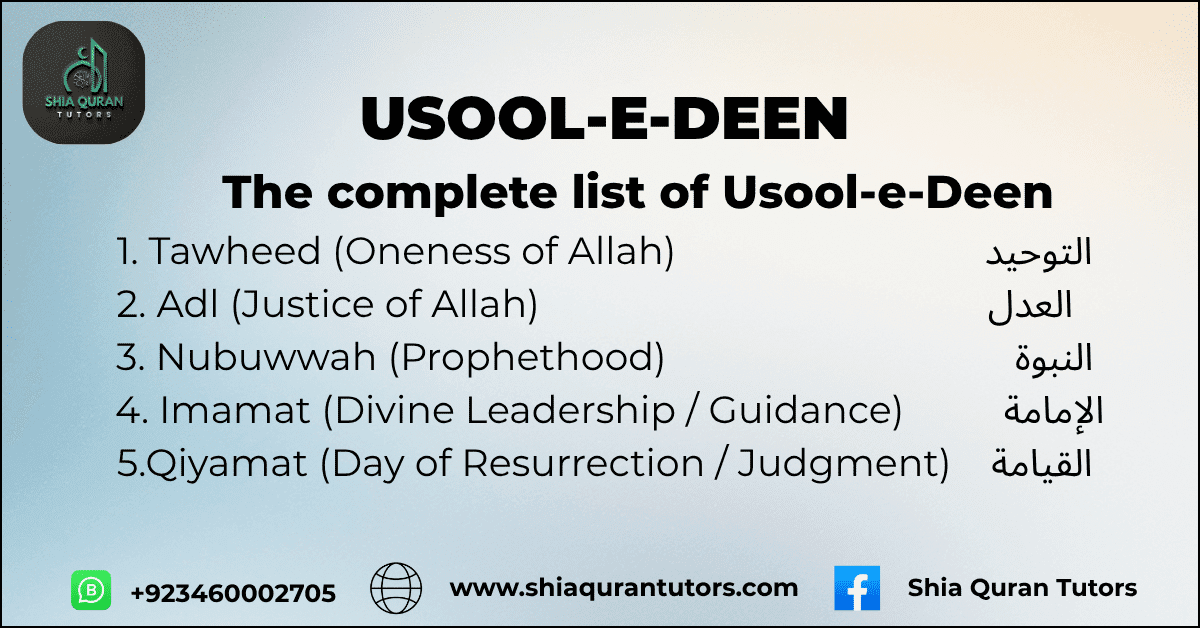
In Islamic thought, Usool-e-Deen—the Roots of Religion—are the fundamental pillars upon which the entire structure of religion is erected. In Islam, the roots consist of five elementary beliefs: Tawheed (Oneness of God), Adl (Justice of God), Nubuwwat (Prophethood), Imamat (Leadership), and Qiyamat (Day of Judgment).
The concept of Usool-e-Deen is the cornerstone of the knowledge of a Muslim about Allah (SWT) and His divine system. A Muslim’s faith is worthwhile only when it is established on the basis of these five principles, which guide intellect, morality, and spiritual growth. All these have their roots deep within the Qur’an as well as that of the Prophet Muhammad (peace be upon him) and his Ahl al-Bayt (A.S.).
The Meaning and Objective of Usool-e-Deen
The term Usool means “roots” and Deen means “religion.” Like the roots of a tree that provide nourishment and stability, Usool-e-Deen gives Islam intellectual and spiritual energy. These are the dogma roots of all Muslims, while Furoo-e-Deen (branches of religion) define the practical acts of worship.
Understanding Usool-e-Deen is necessary since belief without understanding is not complete. Shia scholars stress that every Muslim should arrive at conviction in these fundamentals through independent reasoning rather than imitation. This intellectual effort ensures that faith would be based on knowledge and sincerity.
USOOL-E-DEEN (THE FIVE ROOTS OF RELIGION IN ISLAM):
- Tawheed – The Oneness of Allah
At the very core of Usool-e-Deen is Tawheed, the Oneness of Allah in a complete sense. It enunciates that Allah is one and unique and self-existent and is in need of none; He has no partner or equal. He is the one upon whom all creation is dependent, and none of them is dependent upon Him.
The Qur’an declares:
“Say: He is Allah, the One and Only. Allah, the Eternal, Absolute. He begets not, nor is He begotten. And there is none like unto Him.” (Qur’an 112:1–4)
Tawheed teaches the believers to call upon Allah alone and that all power, wisdom, and authority belong to Him. This understanding eliminates arrogance and reliance on worldly powers. In the field of Usool-e-Deen, Tawheed is the origin of all the other beliefs; it defines the quality of faith and the purpose of human life.
- Adl – The Justice of Allah
The second pillar of Usool-e-Deen is Adl, Allah’s Justice. It signifies Allah is completely fair and never unjust towards His creation. Whatever acts of reward or punishment are done, they are done with complete justice and divine wisdom.
The Qur’an states:
“Surely, Allah does not deal unjustly, even to the weight of an atom, and if there is a good deed, He will double it and give from Himself a great reward.” (Qur’an 4:40)
Adl reassures believers that the tests, blessings, and fortunes of life occur within the framework of Allah’s justice. Adl also emphasizes human responsibility: human beings are provided with free will and are held responsible for what they do. By believing in Usool-e-Deen and its doctrine of Adl, Muslims develop faith in the justice of Allah and try to live justly in their personal and collective life.
- Nubuwwat – The Prophethood
The third element of Usool-e-Deen is Nubuwwat, or Prophethood. According to this belief, Allah selected prophets in order to guide mankind towards truth and righteousness. They all delivered God’s message according to the moral and social needs of their time, culminating in the final Messenger, Prophet Muhammad (peace be upon him).
The Qur’an says:
“Muhammad is not the father of any of your men, but he is the Messenger of Allah and the Seal of the Prophets.” (Qur’an 33:40)
Nubuwwat establishes a direct link between the Creator and creation through Revelation. The prophets did not just deliver laws but also became models of ideal conduct. In Usool-e-Deen, Nubuwwat establishes a chain of God’s intelligence over time and ensures God’s message reaches every community.
- Imamat – The Leadership
Imamat, the fourth pillar of Usool-e-Deen, is God-chosen leadership after the Prophet Muhammad. Shia Islam teaches that Allah appointed twelve Imams from the Prophet’s family (Ahl al-Bayt) to continue his mission, beginning with Imam Ali ibn Abi Talib and ending with Imam Muhammad al-Mahdi, who remains in concealment until his return.
The Prophet said:
“I am leaving behind two weighty matters: the Book of Allah and my Ahl al-Bayt. If you remain firm to them, you shall never go astray.”
This hadith depicts the close interconnection between divine revelation and God-directed leadership. The Imams are successors of the Prophet who hold the right interpretation of Islam. They are models of knowledge, justice, and righteousness.
Among Usool-e-Deen,within Usool-e-Deen, Imamat ensures the continuity of divine guidance, providing insight and authority to the believers of all ages.
- Qiyamat – The Day of Judgment
The final root of Usool-e-Deen is Qiyamat, i.e., belief in the resurrection and the Day of Judgment. According to this principle, life in this world is ephemeral and that every human being will be brought back to life and subjected to God’s justice.
Qur’an says:
“Every soul shall taste death, and you shall only receive your whole reward on the Day of Resurrection.” (Qur’an 3:185).
Belief in Qiyamat instills a strong sense of accountability. It teaches that every action, word, and thought will be taken into account by Allah. To those who have been following the teachings of Usool-e-Deen, the Day of Reckoning is a time of reward and eternal peace. This principle inspires the believers to live ethically and consciously, never forgetting the hereafter.
Interconnection of the Five Roots
The five principles of Usool-e-Deen are interconnected and interdependent. Tawheed outlines the unity of the belief in a single Creator. Adl portrays His justice. Nubuwwat conveys His message through chosen prophets. Imamat continues His leadership through divine appointed leaders. Qiyamat completes the system through accounting and everlasting justice.
They collectively constitute a complete system that governs belief, morality, and conduct. A believer who understands Usool-e-Deen finds purpose and creates the bond with Allah through faith and intellect.
The Importance of Usool-e-Deen
In Islam, Usool-e-Deen is not merely a set of beliefs but an all-encompassing intellectual system of determining divine truth. It encourages asking questions, thinking, and individual belief. Shia ulama concentrate on the fact that real faith springs from knowledge (ma’rifah) and reason (aql), and not blind imitation.
The study of Usool-e-Deen leads to spiritual maturity. It enables Muslims to know why they believe what they do, and not just what they believe. It provides them with an insight that generates commitment to justice, mercy, and self-restraint. The study of the 14 Masomeen (A.S) illustrates how each one of these foundations can be implemented in daily life.
Imam Ali once said:
“The inception of religion is to know Him; testifying to Him is the culmination of knowing Him; believing in His Oneness is the culmination of testifying to Him”
This timelessly universal sentence is symbolic of the rational nature of Usool-e-Deen—a knowledge-and-reason-based religion.
Conclusion
The Usool-e-Deen – The Five Roots of Religion in Islam are the religious foundations on which Islam is based. These five principles—Tawheed, Adl, Nubuwwat, Imamat, and Qiyamat—are the central core of belief that give shape to the moral, spiritual, and intellectual life of all Muslims.
To study Usool-e-Deen is to study the fundamental nature of Islam itself. Through Tawheed, one sees divine oneness; through Adl, divine justice; through Nubuwwat and Imamat, divine guidance; and through Qiyamat, divine accountability. Taken together, they create a worldview based upon faith, justice, and divine purpose.
The believers are encouraged to delve further with authentic sources such as:
Shia.org – The Principles of Faith
By practicing and learning Usool-e-Deen, one strengthens the bond between faith and knowledge so that Islam becomes a living and perfect guide forever.
Frequently Asked Questions (FAQs)
Q1. What is Usool-e-Deen?
It means “Roots of Religion” and refers to the five fundamental beliefs that form the foundation of Shia Islamic creed.
Q2. What are the five fundamentals of Usool-e-Deen?
They are Tawheed (Oneness of God), Adl (Justice), Nubuwwat (Prophethood), Imamat (Leadership), and Qiyamat (Day of Resurrection).
Q3. Why is Usool-e-Deen important?
Because it is certain that understanding and believing in these principles on the basis of knowledge ensures that faith is rational, authentic, and spiritually fulfilling.
Q5. Where can I learn more about Usool-e-Deen?
You may visit Al-Islam.org and IslamicBooks.info for authentic explanations and primary references.
Start Your Free Quran Class Trial Today!

Learn Quran Online | Classes, Tajweed, Tafseer Guide

Vital Secrets of Surah Waqiah for Daily Abundance

Blessed Jumma Mubarak Quotes: Heartfelt Friday Greetings

Reliable Online Quran Classes for Kids | ShiaQuranTutors
Top Islamic Studies Courses Online: Shia Quran Tutors

One Response