
Master Your Connection: The Complete Guide to Prayer Tahajjud
Establishing a consistent routine for prayer tahajjud feels like holding a secret key to a door that most people walk past every day. As someone who has spent a decade helping students at Shia Quran Tutors navigate the spiritual depths of Islam, I have seen how this specific night prayer transforms a person’s internal world.
The silence of the night offers a clarity that the midday sun cannot provide. However, many practitioners struggle with the technicalities—the “when,” the “how many,” and the “what if I’m tired?” This guide provides the answers you need to move from curiosity to consistent practice.
Understanding the Essence of Tahajjud Prayer
Tahajjud is a Nafila (voluntary) prayer. While it is not mandatory like the five daily prayers, its significance in Islamic theology is unparalleled. The word “Tahajjud” stems from the Arabic root h-j-d, which refers to the act of waking up from sleep.
In my experience, the hardest part isn’t the prayer itself; it is the discipline of breaking your sleep. This physical sacrifice proves your sincerity to the Creator. At Shia Quran Tutors, we teach that this prayer is the “station of the elite,” where the soul finds its most intimate dialogue with Allah.
The Scientific and Spiritual "Why"
Why do we pray in the third portion of the night? Modern chronobiology suggests that the brain enters a unique state of receptivity during the early morning hours. Spiritually, this is when the “Divine Descent” occurs, where the mercy of Allah is closest to the earthly realm.
Tahajjud Prayer Time: When Should You Wake Up?
One common misconception is that you can pray Tahajjud immediately after Isha. Technically, you perform tahajjud salaah after waking up from sleep, specifically during the last third of the night.
How to Calculate the Last Third
To find the ideal tahajjud prayer time, follow this simple formula:
Calculate the total hours between Maghrib (sunset) and Fajr (dawn).
Divide that duration by three.
The final segment before Fajr starts is the most blessed time.
If Fajr is at 5:00 AM and Maghrib was at 7:00 PM, the night is 10 hours long. The last third starts roughly 3 hours and 20 minutes before Fajr—around 1:40 AM.
How to Pray Tahajjud: Step-by-Step Instructions
Performing this prayer requires both physical preparation and spiritual intention (Niyyah).
1. The Pre-Prayer Rituals
Intention: Before sleeping, make a firm intention to wake up. Interestingly, if you intend to wake up but sleep through your alarm, you often receive the reward for your intention.
Wudu: Use cold water if you feel drowsy. It shocks the nervous system into a state of “Taqwa” (mindfulness).
2. How Many Rakats is Tahajjud?
The number of rakats is flexible, which is a mercy in itself.
Minimum: 2 Rakats.
Standard: 8 Rakats (performed as four sets of 2 rakats each).
Completion: Many conclude with the Witr prayer (1 or 3 rakats), making the total 11 rakats.
At Shia Quran Tutors, we emphasize that quality exceeds quantity. Two rakats performed with a weeping heart are better than twelve rakats performed with a wandering mind.
3. The Performance
Each set of two rakats follows the standard format of Salat:
Takbir: Start with “Allahu Akbar.”
Recitation: Recite Surah Al-Fatiha followed by any Surah. Many prefer longer recitations like Surah Al-Muzzammil or Surah Yasin.
Ruku and Sujud: Take your time. The prostration (Sujud) in prayer tahajjud is the closest a human being can get to their Creator.
4. The Execution
Each 2-rakat set is performed like a standard Fajr prayer.
Recitation: After Surah Al-Fatiha, recite any Surah you have memorized. If you are teaching online quran classes for kids, encourage them to recite Surah Al-Ikhlas to build confidence.
The Sujud (Prostration): Prolong your Sujud. This is the moment for personal conversation. Ask for your specific needs—whether it is success in your business, the health of your parents, or clarity in your studies.
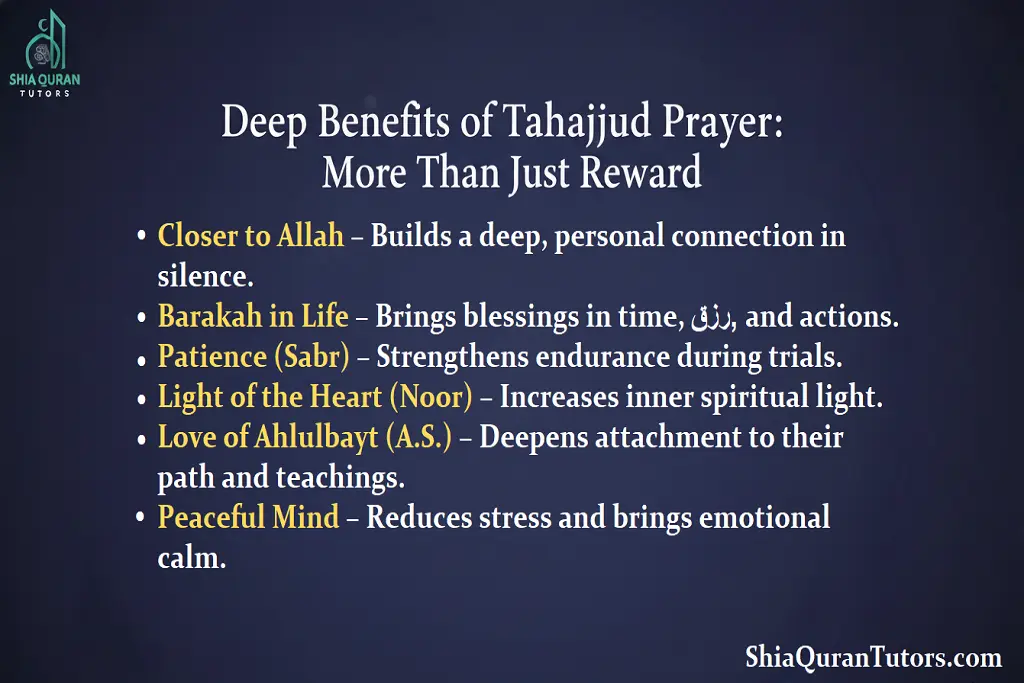
Deep Benefits of Tahajjud Prayer: More Than Just Reward
In 2025 and 2026, we see a massive rise in “mindfulness” and “morning routines” in the corporate world. Islam provided the perfect morning routine 1,400 years ago.
Psychological Resilience
Studies in chronobiology suggest that the quiet focus of the early morning reduces cortisol levels. When you start your day by conquering your desire to sleep, your willpower for the rest of the day becomes impenetrable.
Spiritual Authority
The Quran mentions that the “rising by night” is more potent for the soul and more conducive to the Word (Surah Al-Muzzammil). If you want to understand the Quran deeply, try reading it during this time.
The "Light" in the Face
There is a famous saying that those who pray at night have a certain radiance in their faces during the day. This isn’t just poetry; it is the visible peace of someone who has already settled their biggest worries before the sun came up.
Overcoming Common Challenges
I often hear students say, “I am a heavy sleeper,” or “I work a 9-to-5 job; I’m too tired.” I have faced these same hurdles. Here is how I manage them:
The “No Screens” Rule: Avoid blue light an hour before bed. This ensures your REM sleep is high-quality, making the early wake-up call less painful.
The Power Nap: A 20-minute Qailulah (midday nap) is a Sunnah that specifically provides the energy needed for night worship.
Light Dinners: A heavy stomach leads to a heavy head. Eat lightly to ensure you don’t feel lethargic when the alarm goes off.
Expert Insight: The Shia Quran Tutors Perspective
At our academy, Shia Quran Tutors, we don’t just teach the mechanics of prayer; we teach the philosophy. We believe that tahajjud salaah is the “hidden treasure.” Our curriculum integrates the teachings of the Ahlul Bayt to show how the night prayer serves as a shield against the temptations of the modern digital age. If you are struggling to memorize the specific Duas recited during the night, our tutors provide one-on-one sessions to perfect your recitation and understanding.
Transparency: Is Tahajjud for Everyone?
I want to be objective here. While prayer tahajjud is a fountain of blessings, it is not without its challenges:
The Sleep Debt: If you have a high-stakes job—like a surgeon or a pilot—and waking up for Tahajjud makes you dangerously tired, you should prioritize your sleep. You can pray a shortened version before you sleep.
Burnout Risk: Many people start with too much intensity and quit after two days. Treat this like a marathon. Consistency is the goal.
Conclusion: Starting Your Journey
The path of prayer tahajjud is a marathon, not a sprint. Do not feel discouraged if you miss a night. The fact that you are reading this guide means the invitation has already been extended to you.
If you want to deepen your connection and learn the precise Arabic supplications used by the masters of spiritual light, join us at Shia Quran Tutors. We provide the guidance necessary to turn your night from a time of unconsciousness into a time of divine awakening.
Begin tonight. Set your alarm. Even two rakats can change the trajectory of your life.
FAQs About Prayer Tahajjud
Can I pray Tahajjud without sleeping first?
What if I wake up only 5 minutes before Fajr?
Is it mandatory to recite long Surahs?
Who is Tahajjud NOT for?
What is the minimum number of rakats I can pray?

Best Shia Islamic Teacher Based on Qualifications and Reliable Sources
Evaluate an Islamic studies teacher through relevant qualifications, source handling and a short teaching demonstration.

Shia Quran Teacher for Shia Muslims and a Family Learning Plan
Home Shia Quran Teacher for Shia Muslims and a Family Learning Plan Plan Quran learning around your family. A Shia Quran teacher for Shia Muslims

Hire Shia Quran Teacher Using a Practical Selection Checklist
Use a practical checklist and trial observations to compare Shia Quran teachers before choosing tuition.